Luxury Tandem Skydiving USA: Premium Aviation & Safety Guide
Civilian sport aviation has undergone a distinct structural transformation over the past several decades. Historically, parachuting was viewed as a rugged, minimalist discipline born from military survival protocols. Drop zones operated predominantly out of rustic hangars with basic infrastructure, catering almost exclusively to dedicated licensed jumpers. This operational blueprint left little room for comfort, personalized logistics, or specialized hospitality.
The emergence of high-tier experiential tourism altered this trajectory significantly. As consumer demand shifted toward curated, low-density adventures, specialized aviation operators began re-engineering the tandem jump infrastructure. The focus transitioned from maximizing raw passenger volume to elevating the operational and structural quality of the experience. This transition required substantial capital investment in modern turbine fleets, high-altitude oxygen configurations, and dedicated concierge support structures.
Analyzing this specialized sector requires a thorough investigation of aviation logistics, risk-management systems, and financial frameworks. The premium tier of civilian skydiving cannot be evaluated merely through the lens of leisure. It is an intricate operational ecosystem where regulatory compliance, private aviation infrastructure, and high-quality gear deployment intersect. Examining these variables reveals the complex mechanics that define high-end sport aviation within the United States.
Understanding Luxury Tandem Skydiving USA
To analyze the architecture of luxury tandem skydiving usa, one must decouple the concept from traditional leisure marketing tropes. A premium aviation experience is not defined by superficial amenities or high price tags. Structurally, it represents an intentional reduction in operational friction combined with a significant expansion of technical safety margins and resource allocation.
A common misunderstanding within civilian aviation is that all tandem experiences are bound by identical operational limits. While Federal Aviation Administration regulations establish the baseline safety framework, premium operators establish far more conservative internal thresholds. These thresholds govern weather tolerances, aircraft maintenance intervals, and instructor-to-passenger ratios.
Oversimplifying this sector leads to a failure to understand the underlying logistics. A standard high-volume drop zone prioritizes aircraft optimization by packing cabins to maximum capacity. This methodology increases interior ambient temperature, accelerates passenger fatigue, and restricts individual instruction time.
Conversely, premium operations treat the aircraft cabin as a controlled environment. Low-density manifests ensure that passenger comfort is prioritized during the long ascent. Furthermore, dedicated airspace allocation and customized flight vectors are utilized to provide unhurried freefall sequences over highly scenic geographies.
Deep Contextual Background
The historical trajectory of premium sport parachuting is closely tied to the modernization of civilian turbine aircraft. During the 1970s and 1980s, tandem skydiving systems were developed to allow untrained individuals to experience freefall under direct instructor supervision. These early systems relied primarily on modified cargo planes or small piston-powered aircraft.
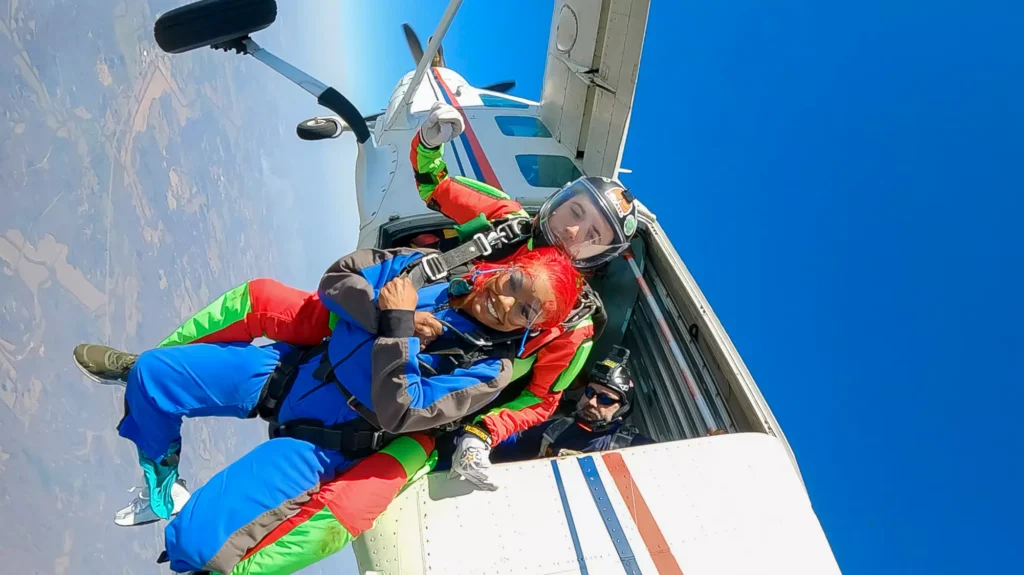
As the demographic profile of experiential travelers evolved in the late 1990s, a structural demand surfaced for customized aviation services. Discerning participants sought alternatives to crowded municipal drop zones. Consequently, operators began acquiring advanced turboprop aircraft, such as the Pacific Aerospace P-750 XSTOL or the Cessna 208 Caravan. These platforms provided faster climb times, quieter cabin environments, and superior safety records.
In the current aviation market, this evolution has expanded into the integration of private jet charters and exclusive airport terminal access. Elite drop zones no longer operate in isolation from mainstream private aviation infrastructure. By aligning with Fixed-Base Operators at regional airports, modern providers can deliver seamless transfers from cross-country private flights directly to dedicated jump platforms.
Conceptual Frameworks and Mental Models
Evaluating high-tier skydiving operations requires specific frameworks that account for both human performance and technical systems.
The Low-Density Safety Buffer Model
The primary framework utilized is the Low-Density Safety Buffer Model. This model stipulates that human error rates decrease when the operational tempo is intentionally slowed. In high-volume environments, instructors are subjected to rapid turnaround cycles, often packing and jumping six to eight times per day.
By capping an instructor’s daily load to a maximum of two or three jumps, a premium operation preserves cognitive reserves. This approach ensures that emergency procedures are rehearsed thoroughly before every takeoff. The operational limit of this model is determined by fixed overhead costs, which require a higher baseline price per jump to sustain the low-volume structure.
The Margin of Environmental Exclusivity Framework
A secondary framework is the Margin of Environmental Exclusivity. This model evaluates the trade-offs involved in selecting highly complex jump locations, such as mountainous coastlines or restricted island airspaces. While these environments offer unparalleled visual geography, they introduce complex microclimates and strict air traffic control limitations.
The model forces operators to maintain highly flexible scheduling windows. This flexibility allows them to postpone flights indefinitely until optimal atmospheric conditions are met, without experiencing commercial pressure to clear a crowded manifest.
Key Categories and Technical Variations
High-tier tandem operations across the United States can be segmented into distinct operational categories, each featuring specific infrastructure and trade-offs.
High-Altitude HALO Operations
High Altitude Low Opening (HALO) flights represent the highest tier of technical skydiving. Operating at altitudes between 18,000 and 28,000 feet, these jumps require specialized supplemental oxygen systems for both the instructor and the passenger.
The primary advantage is an extended freefall duration that can exceed two full minutes. However, the physical toll is substantial, requiring physiological pre-breathing periods to mitigate decompression sickness risks.
Private Drop Zone Takeovers
This variation allows a single party to secure exclusive rights to an entire aviation facility and fleet for a designated timeframe. This model eliminates all external traffic, allowing the flight patterns and jump schedules to be customized completely around the client’s logistical preferences.
The logistical trade-off involves significant coordination with regional air traffic control authorities to close specific airspace corridors temporarily.
Scenic Marine Inversions
Operating along coastal boundaries, these programs utilize premium aircraft to drop passengers directly over maritime landscapes, such as Key West or the California coastline.
The primary technical challenge involves managing sudden marine layers and offshore wind shifts, which require highly experienced pilots and conservative jump matrices.
Remote Wilderness Inserts
These programs combine premium tandem jumps with back-country exploration. Passengers land in remote, undeveloped locations such as deep desert canyons or high-alpine meadows, where a luxury ground camp or helicopter transport is positioned for immediate extraction.
The operational complexity requires extensive ground-to-air communication networks and highly precise canopy steering.
Detailed Real-World Scenarios
Scenario A: Executing a Private Takeover Amid Airspace Constraints
A corporate group utilizes a private drop zone takeover near a major metropolitan area on the East Coast. The flight plan requires ascending through a heavily congested commercial aviation corridor.
-
Constraint: The regional air traffic control center issues a sudden hold order due to arriving commercial liner traffic, trapping the jump aircraft at 10,000 feet.
-
Decision Point: The pilot must choose whether to descend and scrub the mission, or hold at altitude while managing fuel reserves and passenger comfort.
-
Failure Mode: Forcing the jump during a narrow gap without explicit ATC clearance, resulting in a severe regulatory violation and airspace conflict.
-
Second-Order Effect: The operator loses its letters of agreement with the local airport authority, suspending all premium operations indefinitely.
Scenario B: Managing Oxygen System Anomalies During a HALO Jump
During an ascent to 24,000 feet in the Southwest desert, a passenger’s supplemental oxygen regulator shows a fluctuating pressure reading at 20,000 feet.
-
Constraint: The cabin is unpressurized, and the time of useful consciousness drops rapidly above 22,000 feet.
-
Decision Point: The instructor must immediately decide whether to deploy the backup oxygen bottle or initiate an emergency aircraft descent.
-
Failure Mode: Ignoring the fluctuating gauge under the assumption that the primary system is functioning, leading to hypoxia during the final jump sequence.
-
Second-Order Effect: The passenger experiences cognitive disorientation during freefall, complicating the tandem drogue deployment and canopy opening sequence.
Planning, Cost, and Resource Dynamics
Securing a premium tandem experience involves distinct financial and capital commitments that far exceed standard recreational rates. These costs reflect the low-density nature of the operations and the utilization of high-performance assets.
| Cost Allocation Category | Budget Range (USD) | Core Operational Drivers |
| High-Altitude Custom Tandem | $1,500 – $3,500 | Dedicated turbine usage, custom flight pathing, high-altitude oxygen infrastructure. |
| Exclusive Facility Takeover | $12,000 – $25,000 / Day | Full fleet grounding for public use, dedicated ATC coordination, concierge staff. |
| Advanced Multi-Angle Media | $800 – $1,800 | Dedicated freefall camera flyers, high-definition stabilization gear, rapid editing setups. |
| Remote Landing Logistics | $3,000 – $7,500 | Ground transport scouting, private property leasing, helicopter extraction standby. |
Indirect Constraints and Scheduling Volatility
Beyond direct financial outlays, the primary resource variable is time availability. Premium skydiving operations cannot be forced through unfavorable weather systems.
Participants must allocate flexible multi-day arrival windows to account for wind shear, low-lying cloud decks, or atmospheric turbulence, ensuring that the jump is executed only under optimal conditions.
Tools, Strategies, and Support Systems
The execution of a high-end tandem program relies on a suite of advanced technical tools and safety equipment.
Dual-Hawk Tandem Systems with Mypath Computations
Modern premium operators utilize advanced harness systems equipped with dual-parachute deployment mechanisms. These systems are paired with integrated flight computers that track exact descent profiles based on real-time barometric pressure shifts.
Military-Grade Oxygen Consoles
For high-altitude profiles, multi-place oxygen delivery systems are hard-mounted into the aircraft cabin. These units deliver pulse-dose medical oxygen, maximizing efficiency and preventing passenger discomfort during long ascents.
Stabilized Freefall Camera Arrays
Rather than relying on basic wrist-mounted cameras, high-tier experiences utilize dedicated professional videographers who jump alongside the tandem pair. These flyers use helmets equipped with three-axis stabilized cameras to capture cinematic footage without disrupting the instructor’s physical movements.
Risk Landscape and Failure Modes
The safety profile of premium aviation is defined by a commitment to mitigating compounding risks before they manifest into system failures.
Detailed Risk Breakdown
-
Microclimatic Volatility: Rapid changes in wind gradients near local terrain features can destabilize a parachute canopy during its final landing flare.
-
High-Altitude Hypoxia: Subtle oxygen deprivation can impair an instructor’s reaction time during the critical first five seconds of freefall.
-
Off-Field Landing Complications: Landing outside the designated drop zone due to tracking errors introduces immediate hazards from fences, trees, or local power structures.
-
Mechanical Component Stress: High-performance turbine planes experience accelerated wear cycles when subjected to rapid ascents and descents, requiring precise maintenance tracking.
Governance, Maintenance, and Long-Term Adaptation
All premium sport aviation operations in the United States operate under the strict oversight of the FAA and the United States Parachute Association. Maintenance programs for specialized tandem gear must follow rigorous inspection cycles. Parachute rigs must be inspected and repacked by an FAA-certified rigger every 180 days, regardless of actual usage levels.
Long-term operational adaptation requires drop zones to constantly evaluate their local environments. As urban development expands around regional airports, landing corridors naturally narrow. Premium operators must establish binding land-use agreements with adjacent properties to guarantee clear emergency overshoot lanes, ensuring the long-term viability of their flight operations.
Measurement, Tracking, and Evaluation
Drop zone safety directors utilize a matrix of qualitative and quantitative indicators to maintain operational consistency and evaluate system health.
Quantitative Performance Metrics
-
Ground Track Deviation Index: Measuring the distance between the intended landing target and the actual touchdown point across all tandem pairs.
-
Turbine Cycle Efficiency Ratio: Tracking engine temperature parameters during high-speed climbs to identify early signs of compressor fatigue.
-
Barometric Opening Variance: Assessing the precision of main canopy deployment altitudes via electronic altimeter logs.
Qualitative Evaluation Signals
-
Passenger Cognitive Tracking: Assessing a participant’s verbal responsiveness during the pre-jump brief at high altitude to check for early signs of hypoxia.
-
Instructor Physical Longevity: Monitoring jumpmasters for signs of repetitive motion strain or chronic altitude fatigue to prevent performance drops.
Ethical and Practical Considerations
Operating low-density, high-altitude turbine flights requires a careful evaluation of environmental impacts. High-performance aircraft consume substantial amounts of fuel during steep ascents, prompting modern premium operators to invest in carbon-offset programs or transition toward more fuel-efficient single-engine turboprops.
Additionally, operators must balance their flight tracks to minimize noise disturbances over local residential communities, ensuring that luxury aviation practices do not compromise the peace and accessibility of shared regional airspaces.
Synthesis and Evaluation
The landscape of luxury tandem skydiving usa represents a sophisticated fusion of advanced aviation technology, meticulous risk management, and client-focused logistics. By prioritizing low operational density, utilizing cutting-edge safety gear, and maintaining conservative weather thresholds, premium providers deliver experiences that far exceed standard recreational baselines.
Success in this specialized sector is ultimately measured not by opulent ground amenities, but by an operator’s unwavering commitment to technical precision, regulatory compliance, and human performance optimization within a dynamic flight environment.