How to Manage Skydiving Anxiety: Complete Psychological & Technical Guide
The human nervous system is highly optimized for terrestrial survival. When an individual stands at the open door of an aircraft traveling at twelve thousand feet, the brain encounters a stimulus package that violates basic evolutionary programming. The resulting physiological and psychological response is often categorized simply as fear. However, a more precise diagnostic lens reveals a complex intersection of acute stress, cognitive overload, and spatial disorientation. Addressing this state requires more than superficial reassurances or generic breathing exercises. It demands a systematic decompression of the neurological and structural mechanisms that drive high-altitude distress.
Developing a functional approach to high-altitude stress mitigation requires an understanding of both the sport’s mechanical redundancies and the body’s chemical signaling. Anxiety in this context is not an indicator of personal failure or structural vulnerability. Instead, it is a predictable response to an engineered environment that strips away familiar physical references. By analyzing how the mind processes perceived mortality risks against actual statistical baselines, participants can transition from a state of blind panic to one of calculated risk management. This transition forms the core foundation of sustained performance in aviation environments.
This definitive reference guide explores the anatomical, psychological, and operational dimensions of pre-jump distress. It avoids the common platitudes found in standard instructional manuals. Instead, it offers a rigorous, structurally diverse analysis designed for individuals seeking absolute cognitive control over their descent. Through the integration of aviation psychology, behavioral frameworks, and equipment mechanics, the following sections provide a comprehensive blueprint for neutralizing paralyzing apprehension and achieving operational clarity during freefall.
Understanding “how to manage skydiving anxiety”
To systematically address pre-jump panic, one must first deconstruct the phrase itself. Knowing how to manage skydiving anxiety requires an understanding that fear cannot be completely eliminated. Nor should it be. A total absence of apprehension often signals complacency, which introduces severe operational risks in aviation environments. True management involves the deliberate transformation of visceral panic into hyper-vigilant situational awareness. This process requires a clear division between real mechanical threats and benign sensory overload.
Oversimplified approaches to this challenge often rely on forced positive thinking or chemical suppression. These methods fundamentally fail when the aircraft door opens. A human cannot easily trick the amygdala when facing a high-velocity airflow and a distant horizon. When a jumper tries to suppress anxiety through denial, the physiological response often intensifies. This dynamic can lead to cognitive freezing, a state where a jumper becomes unable to perform basic safety functions like altitude monitoring or handle deployment.
Effective management is built on intellectual honesty and sensory habituation. The brain must learn to categorize the physiological symptoms of adrenaline, such as an elevated heart rate, vasoconstriction, and rapid respiration, as performance-enhancing adaptations rather than signs of impending doom. When these bodily changes are recontextualized as a normal preparation for high-velocity sports, the cognitive loop shifts from fear to focused readiness. This shift preserves executive function when it is needed most.
The Deep Contextual Evolution of Altitude Psychology
The study of human behavior during high-altitude descents originated in military research programs during the mid-twentieth century. Early paratrooper training operations revealed that a high percentage of injuries occurred due to psychological freezing rather than mechanical equipment malfunctions. Soldiers frequently failed to pull their ripcords or lost awareness of their altitude because of extreme sensory overload. This reality forced military psychologists to study the exact mechanisms of acute survival stress in aviation environments.
Early training systems focused primarily on physical repetition and strict discipline. While this approach built muscle memory, it did not address the root cognitive disruptions caused by fear. As civilian skydiving evolved from a military surplus activity into a highly regulated sport in the late twentieth century, training methods changed significantly. The introduction of Accelerated Freefall (AFF) programs shifted the instructional focus from blind obedience to conscious, autonomous survival skills from the very first jump.
Modern skydiving psychology incorporates elements of cognitive behavioral therapy, sports science, and human factors engineering. Current methodologies treat pre-jump anxiety as a predictable variable within the broader system of aviation safety. The development of highly reliable safety devices, such as the Automatic Activation Device (AAD), has also fundamentally altered the psychological landscape. By providing an automated mechanical backup for parachute deployment, these systems reduce the absolute fear of impact, allowing students to focus on learning stable body flight.
Cognitive Frameworks and Mental Models
The Amygdala Hijack and Cortical Override Model
The primary neurological challenge during a skydive is managing the structural conflict between the primitive limbic system and the prefrontal cortex. The limbic system reacts instantly to heights and high-velocity environments by triggering a sympathetic nervous system response. This reaction floods the body with cortisol and epinephrine. To maintain motor control, the prefrontal cortex must actively override these signals using logical verification. This process requires a continuous stream of objective data, such as altimeter readings and visual structural checks, to prove that safety systems are working correctly.
The Inversion of Control Framework
In everyday life, safety is maintained by avoiding hazards entirely. Skydiving requires an inversion of this framework. Safety is instead achieved by entering a high-hazard environment while carrying redundant mitigation tools. Apprehension often spikes because the human mind confuses a high-consequence environment with a high-probability accident scenario. By separating consequence from probability, a jumper can logically accept that while freefall carries catastrophic potential, the statistical likelihood of an incident remains low when correct procedures are maintained.
The OODA Loop Under High Stress
The Observe, Orient, Decide, Act (OODA) loop accelerates dramatically during freefall. Under extreme anxiety, the “Orient” phase often breaks down because the brain cannot process the unfamiliar visual and vestibular inputs of unregulated descent. This breakdown stalls the entire loop, leading to indecision or delayed actions. To prevent this failure, jumpers must simplify their orientation phase through extensive dirt-diving (practicing the dive flow on the ground). This ground practice builds clear mental pathways that bypass the need for complex decision-making in the air.
Categorization of Anxiety Thresholds and Jump Profiles
Anxiety presents differently across various experience levels, equipment types, and environmental conditions. Each distinct profile requires a tailored mitigation approach to ensure safety and performance.
The transition between these profiles requires a systematic increase in cognitive load. A student cannot safely manage the anxiety of solo canopy flight until they have habituated to the sensory shock of the initial exit. Therefore, training progression must be tightly controlled. This structure prevents sensory saturation and ensures that safety-critical actions remain within the jumper’s functional capacity.
Detailed Real-World Scenarios and Operational Failures
Scenario A: The Catatonic AFF Student Exit
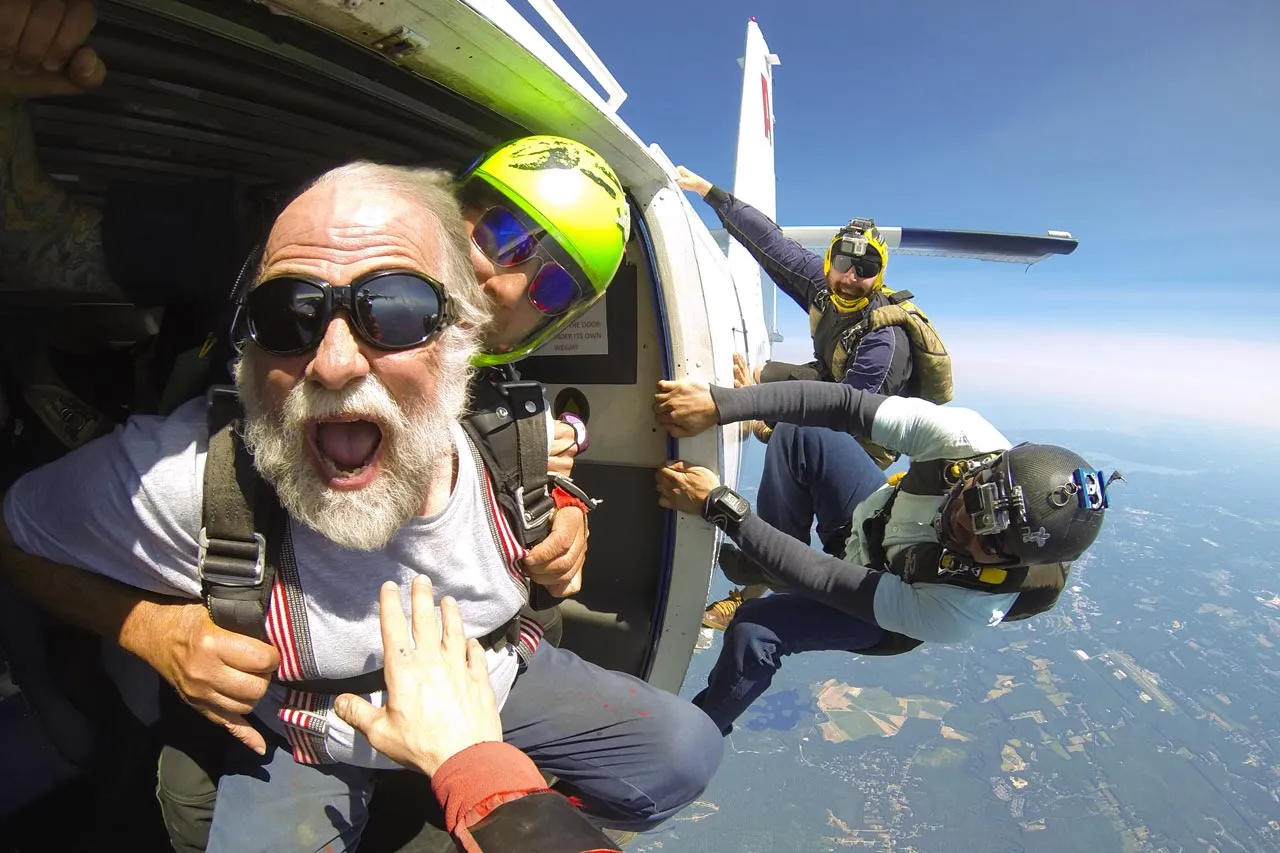
An AFF Student experiences a severe panic attack at the aircraft door at 13,000 feet. The student freezes, grips the door frame tightly, and ignores verbal instructions from the instructors.
-
Constraints & Structural Demands: The jump run cannot be held indefinitely due to air traffic control limits and fuel consumption. The instructors must manage the student without compromising their own safety or aircraft stability.
-
Decision Points: Instructors must quickly evaluate whether the student can be peeled from the door safely or if the jump must be aborted.
-
Failure Modes: Forcing an unstable exit with a rigid, unresponsive student can lead to immediate spinning upon leaving the aircraft, increasing the risk of an accidental collision.
-
Second-Order Effects: An aborted jump can create deep psychological barriers for the student, significantly increasing anticipatory anxiety for future attempts.
Scenario B: Mid-Flight Canopy Line Twist Over-Correction
A newly licensed jumper experiences line twists immediately after canopy deployment at 3,500 feet. High anxiety causes them to panic and pull hard on the steering toggles before clearing the twists.
-
Constraints & Structural Demands: The jumper has a hard decision altitude of 2,500 feet to execute emergency procedures if the canopy remains uncontrollable.
-
Decision Points: The jumper must decide whether to kick out of the twists or cut away the main canopy immediately.
-
Failure Modes: Pulling the toggles stalls one side of the twisted canopy, causing it to enter a violent, high-speed spiral.
-
Second-Order Effects: The rapid rotation causes spatial disorientation, making it difficult to find and pull the cut-away and reserve handles in the correct order.
Scenario C: The Low-Altitude Altimeter Fixation
During an un-docked relative work jump, a jumper loses track of time and becomes anxious about their actual altitude. They fixate exclusively on their wrist altimeter, completely ignoring the surrounding airspace and other flyers.
-
Constraints & Structural Demands: Multiple jumpers are descending rapidly in close proximity, requiring continuous visual tracking of nearby traffic.
-
Decision Points: The jumper must balance checking their instruments with maintaining visual awareness of other participants.
-
Failure Modes: Looking down continuously leads to a complete loss of situational awareness, creating a major danger of a high-speed freefall collision during tracking or deployment.
-
Second-Order Effects: The jumper may deploy their parachute while directly underneath another flyer, risking a canopy entanglement.
Scenario D: The Windy Canopy Pattern Panic
A jumper finds themselves downwind of the landing zone at 1,000 feet with unexpectedly strong headwinds. Anxiety spikes as they realize they might not clear a row of trees near the drop zone boundary.
-
Constraints & Structural Demands: Low altitude leaves no room for major canopy changes or reserve deployments.
-
Decision Points: The jumper must choose between making a dangerous, low-altitude turn back toward the drop zone or preparing for an off-field landing in an open area.
-
Failure Modes: Panicking and executing a low, sharp turn into the wind can cause a high-speed impact with the ground.
-
Second-Order Effects: Choosing an off-field landing without a clear plan can lead to collisions with hidden obstacles like power lines or fences.
Resource Dynamics, Training Commitments, and Economics
Managing high-altitude stress requires investments that extend well beyond the cost of a standard jump ticket. True psychological habituation is built on high jump frequency, specialized coaching, and regular simulator training.
When a jumper reduces their jump frequency to save money, they often experience currency degradation. This gap between jumps allows anticipatory anxiety to rebuild, forcing the jumper to spend more mental energy managing fear on their next flight. Therefore, maintaining a consistent jump schedule is a critical element of long-term stress management.
Structural Strategies and Biological Support Systems
Tactical Breathing Patterns
The sympathetic nervous system can be modulated through deliberate respiration adjustments. Box breathing (inhaling for four seconds, holding for four seconds, exhaling for four seconds, and holding for four seconds) activates the vagus nerve. This activation helps lower an elevated heart rate and counteracts the shallow, rapid breathing caused by fear. Jumpers should use this technique during the plane ride up, especially between 8,000 feet and the final exit altitude, to keep their cognitive focus sharp.
Somatic Grounding and Gear Checks
Anxiety often pulls a jumper’s focus away from the present moment and into imagined future accidents. Somatic grounding techniques bring the focus back to current physical realities. By physically touching and inspecting three critical points of their equipment—the three-ring release system, the chest strap, and the altimeter—jumpers create an objective feedback loop. This physical action confirms their gear is secure, giving the logical mind concrete data to counter vague, anxious thoughts.
Cognitive Reframing
The physical sensations of fear are almost identical to those of high excitement. Both states cause a racing heart, sharp focus, and a burst of energy. Jumpers can reframe their anxiety by consciously labeling these sensations as excitement rather than fear. This simple change in perspective alters how the brain processes stress signals. It prevents the mind from entering a defensive panic mode and instead prepares it for high-performance action.
Risk Taxonomies and Compounding Failure Modes
Chronic Currency Degradation
When a jumper goes long periods without making a jump, their mental comfort with the aviation environment fades quickly. This degradation increases baseline anxiety during subsequent jumps, which often leads to poor field vision and slower reaction times under canopy.
Task Saturation and Cognitive Freezing
When a jumper experiences high anxiety, their brain uses significant cognitive energy just trying to manage fear. This reduction in available mental capacity can cause task saturation during complex jumps. If a minor problem occurs, the jumper may experience cognitive freezing, leaving them unable to prioritize and execute basic safety procedures.
Social Group Pressures
Jumpers sometimes agree to participate in advanced or complex skydives before they are mentally ready, driven by a desire to fit in with more experienced peers. This choice can push their anxiety past a manageable level, increasing the risk of mistakes during the jump.
Long-Term Adaptation, Currency, and Maintenance Protocols
Recency and Currency Standards
To manage anxiety effectively over the long term, jumpers must follow strict currency guidelines that match their experience level. For student pilots, a jump frequency of at least once every fifteen days is highly recommended to maintain comfort in the air. For licensed jumpers, a minimum of one jump every thirty days is required by regulatory bodies to maintain basic currency. If a jumper falls out of currency, they should complete a structured refresher course with a rated instructor rather than attempting to jump alone.
Seasonal Adaptation Strategies
Jumpers who live in areas with long winters often experience a sharp return of pre-jump anxiety during their first few jumps of the spring. To manage this seasonal spike, the first jump of the year should always be a simple, low-stress solo dive. This allows the jumper to rehabituate to the sensory rush of freefall without the added pressure of tracking or flying with a group.
Pre-Flight Preparation Checklist
-
Neurological Baseline Check: Assess your current resting pulse rate and verify that you can focus clearly on simple tasks without experiencing tunnel vision.
-
Three-Point Gear Inspection: Physically verify the alignment of the three-ring release system, check the reserve pin container seal, and confirm that the AAD is switched on and set to the correct ground elevation.
-
Visual Flight Plan Walkthrough: Visualize the exact jump flow from the initial aircraft exit down to the final landing pattern, noting key altitude targets along the way.
-
Environmental Assessment: Check current wind speeds, evaluate cloud base altitudes, and locate nearby off-field landing zones from the ground before boarding.
Metric Evaluation, Documentation, and Signal Tracking
Systematic improvement requires objective tracking of a jumper’s psychological state across multiple jumps. Jumpers should record these metrics in their personal logbooks to identify patterns and track their adaptation over time.
Metric Signal Classifications
-
Leading Indicators: Anticipatory pulse rate trends taken during the drive to the drop zone; the quality and consistency of pre-flight visualization practices.
-
Lagging Indicators: Total freefall time executed without experiencing involuntary tunnel vision; accuracy in hitting the planned landing target.
-
Qualitative Signals: Self-reported scores reflecting comfort levels at the open aircraft door; the clarity of visual tracking during group breakaways.
-
Quantitative Signals: Discrepancies between planned parachute deployment altitudes and actual activation heights recorded by digital altimeters.
Deconstruction of Common Misconceptions
Myth: True Skydivers Never Experience Fear
Experienced jumpers feel fear regularly. The difference lies entirely in how they process the emotion. While a beginner may interpret fear as a signal to freeze or panic, a veteran uses that rush of adrenaline to sharpen their focus and verify safety steps.
Myth: Deep Breathing Eliminates Pre-Jump Stress
Breathing exercises are designed to manage the physical symptoms of stress, not eliminate the mental challenge of jumping. They keep your heart rate down and prevent hyperventilation, ensuring your brain receives enough oxygen to make clear decisions in the air.
Myth: Memorizing Emergency Steps Stops Panic
Knowing your emergency procedures is essential, but pure memorization can fail under extreme stress. True confidence comes from regular physical practice on the ground, which builds the muscle memory needed to act correctly even when panicking.
Myth: Advanced Equipment Solves Gear Anxiety
Newer, higher-performance gear does not automatically reduce stress. In fact, advanced parachutes often require more precise control and quicker decision-making, which can actually increase anxiety for less experienced jumpers.
Myth: Anxiousness Means You Aren’t Cut Out for the Sport
Experiencing anxiety is a normal, healthy sign that your body’s survival instincts are working correctly. Learning how to manage skydiving anxiety is a standard part of training that almost every jumper goes through as they adapt to the sport.
Myth: Pushing Through Intense Panic Builds Confidence
Forcing yourself to jump while in a state of blind panic rarely leads to confidence. Instead, it often causes sensory overload and poor performance, which can increase fear on future jumps. It is much more effective to step back and lower stress levels through gradual exposure.
Structural Integration and Operational Synthesis
Managing high-altitude stress is not about showing bravado or trying to ignore your survival instincts. It is an exercise in applied human factors engineering. The goal is to build reliable mental habits that match the high reliability of modern skydiving equipment. By recognizing that anxiety is a predictable physiological response to an extreme environment, a jumper can stop fighting the emotion and start managing it systematically.
Long-term success in aviation requires a willingness to look closely at your own psychological weak spots. It demands regular practice of basic survival skills, a commitment to keeping your skills current, and an honest assessment of your mental state before every jump. When physical preparation, equipment checks, and breathing techniques are used together, the character of a skydive changes completely. The jump is no longer a terrifying leap into the unknown, but a structured, intentional sequence of flight maneuvers executed with clarity and control.