Best Skydiving for Adrenaline Seekers: Elite Drop Zones & Extreme Disiplines
The pursuit of high-altitude deceleration attracts a specific cohort of aviation enthusiasts. While standard tandem jumps introduce civilians to terminal velocity, true adrenaline seekers require parameters that push the absolute boundaries of human flight. This level of aviation demands significant technical understanding, physiological resilience, and precise execution. The landscape of extreme parachuting shifts constantly as equipment design matures and physiological thresholds are redefined by high-altitude exploration.
Evaluating aviation experiences requires a shift away from standard tourism metrics. The focus moves toward environmental complexity, aircraft capabilities, and the specific aerodynamic disciplines permitted by regional drop zones. A location offering the ultimate thrill cannot be judged solely by its scenery. Instead, it must be evaluated by the velocity of its exit aircraft, the thinness of its upper-atmosphere air, and the structural complexity of its local terrain. These variables transform a standard freefall into a highly technical exercise in risk management.
Achieving peak neurological stimulation in modern aviation is closely linked to the mastery of advanced aerodynamic principles. Adrenaline production ceases to be a product of blind terror. Instead, it becomes a reward for managing high-speed variables under intense physical pressure. Consequently, the search for extreme experiences transitions from a bucket-list quest into a dedicated study of atmospheric mechanics, specialized equipment configurations, and human physiology. This foundational analysis establishes the structural and operational frameworks that define elite aerial endeavors.
Understanding “best skydiving for adrenaline seekers”
Defining the best skydiving for adrenaline seekers requires moving past standard promotional definitions. Most commercial marketing conflates scenic beauty with actual neurological stimulation. A jump over an island resort may offer aesthetic appeal, but it rarely provides the specialized operational conditions that experienced jumpers demand. The true baseline for an extreme experience involves pushing the variables of altitude, speed, and environmental hostility to their logical limits.
True thrill-seeking in aviation is fundamentally misunderstood by the public. Laypersons often assume the thrill stems from a chaotic loss of control, whereas experienced aviators find stimulation in maintaining precise control within highly unstable environments. The sensation of speed changes dramatically when shifting from a belly-to-earth orientation to vertical or angled flight profiles. In these advanced orientations, terminal velocity increases from 120 miles per hour to over 200 miles per hour. This change alters the physical demands on both the jumper and their equipment.
Selecting a drop zone based entirely on altitude is another common oversimplification. While high-altitude low-opening (HALO) operations offer prolonged freefall, they also introduce complex physiological challenges like hypoxia and decompression sickness. The ideal environment combines advanced aircraft performance with progressive coaching staff and permissive airspace regulations. Without these operational elements, a drop zone cannot support the high-speed disciplines that define modern, high-intensity human flight.
The Evolution of Aerial Extremes
The historical trajectory of sport parachuting explains the current state of high-velocity flight. Early aviation developments focused purely on survival mechanisms for pilots exiting compromised aircraft. Static-line deployment systems dominated early military configurations, prioritizing predictable canopy openings over freefall duration. As surplus equipment entered the civilian market post-World War II, experimental jumpers began modifying gear to extend freefall time. This experimentation laid the groundwork for modern sport parachuting.
The transition from round canopies to ram-air square canopies during the late 1960s changed the sport permanently. Round parachutes offered limited steerability and high landing impact forces, restricting jumps to benign meteorological conditions. Ram-air canopies operate as inflatable wings, generating forward speed and aerodynamic lift. This technological shift allowed jumpers to actively pilot their canopies, turning the landing sequence from a passive impact into a high-speed, dynamic maneuver.
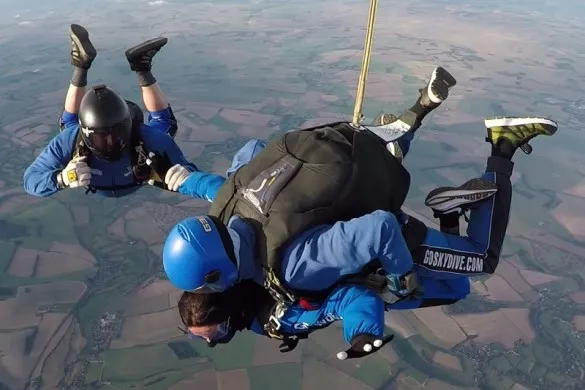
During the late 1990s and early 2000s, the development of cross-braced canopies and specialized tracking suits expanded performance boundaries. Wing loading—the ratio of jumper weight to canopy surface area—increased significantly. This enabled speeds that were previously impossible for soft nylon wings. Simultaneously, the introduction of vertical wind tunnels allowed flyers to practice complex aerodynamic body positions in controlled environments. This accelerated skill acquisition and led directly to the high-speed group disciplines practiced today.
Conceptual Frameworks for High-Velocity Risk
The Risk-Competency Matrix
Navigating extreme aviation environments requires a structured understanding of how human skill interacts with environmental danger. The Risk-Competency Matrix serves as a vital framework for assessing jump safety. This model plots environmental hostility against the jumper’s current technical proficiency. High-velocity operations require that a jumper’s analytical capacity matches or exceeds the complexity of the aerial environment. When a participant enters a high-risk scenario without matching skills, the probability of an accident increases exponentially.
The Error Chain Model
Aviation safety analysis relies heavily on the Error Chain Model. This framework states that major accidents rarely result from a single isolated equipment failure or human miscalculation. Instead, mishaps occur when a sequence of minor, manageable discrepancies links together uninterrupted. In high-speed skydiving disciplines, where time is measured in seconds, an uncorrected error early in the jump sequence compounds rapidly. Breaking this chain requires early identification of anomalies and immediate corrective action.
The Human Factors Analysis and Classification System (HFACS)
Originally designed for military aviation, HFACS categorizes the underlying causes of human error during complex operations. The framework divides failures into four distinct levels: unsafe acts, preconditions for unsafe acts, unsafe supervision, and organizational influences. For adrenaline seekers operating at elite drop zones, this model highlights that safety is not just an individual responsibility. The operational culture of the drop zone, the maintenance standards of the aircraft pilots, and peer group behavior collectively dictate the baseline safety of any high-risk jump.
Core Categories of Extreme Skydive Disciplines
High-Altitude Low-Opening (HALO)
HALO operations represent a peak experience for those pursuing the best skydiving for adrenaline seekers. These jumps require exitting an aircraft at altitudes between 22,000 and 30,000 feet, which requires supplemental oxygen systems. The initial freefall occurs in thin air, offering minimal aerodynamic resistance and a unique sensation of floating before entering denser atmospheric layers. The primary trade-off is physiological; mistakes in oxygen management can lead to rapid hypoxia, causing unconsciousness within seconds.
Vertical Formation Skydiving (VFS)
VFS shifts human flight from a horizontal plane to a high-velocity vertical axis. Jumpers fly in head-down or head-up orientations, maintaining precise formations while moving at speeds exceeding 200 miles per hour. This discipline demands extreme core strength, spatial awareness, and fast cognitive processing. The margin for error is minimal, as accidental collisions at vertical velocities can cause severe physical trauma or structural equipment failure.
High-Performance Canopy Piloting (Swooping)
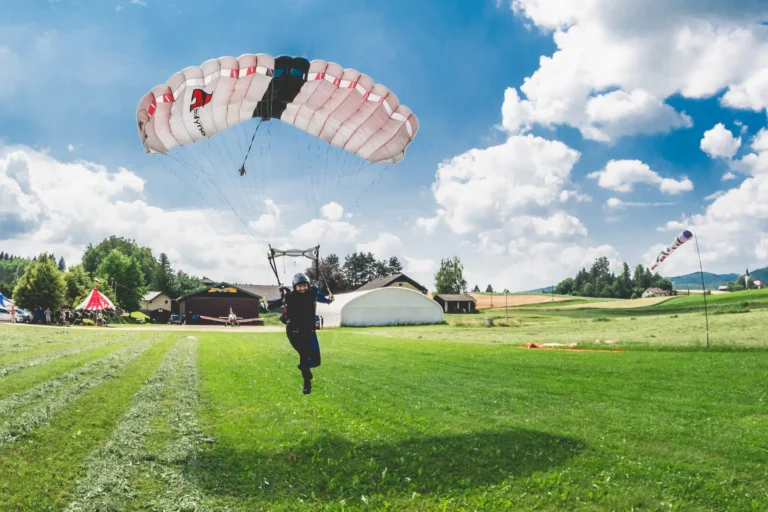
Swooping focuses entirely on the open-canopy phase of the jump. Pilots initiate high-degree asymmetric turns close to the ground, using gravity to accelerate their small, cross-braced wings. This dive generates significant speed, which is then translated into a long horizontal glide just inches above a body of water or a manicured landing zone. The adrenaline return is significant due to the visual proximity of the ground, but a misjudged turn altitude leaves no time for correction before impact.
Angle Flying and Tracking
Angle flying involves tilting the body to translate vertical descent into rapid horizontal movement across the sky. This discipline turns the jumper into a human lifting body, creating a high-speed glide path relative to the ground. Groups of jumpers flying at steep angles must maintain tight formations while tracking across the sky. The chief operational challenge is navigation; deviating from the planned flight path can lead to airspace conflicts with other jump groups or put participants outside the landing zone’s boundaries.
Real-World Flight Scenarios and Operational Realities
High-Altitude Execution in Sub-Zero Conditions
An operational flight plan targeting 28,000 feet requires precise execution. The jump ship, typically a modified multi-engine turboprop, spends forty-five minutes climbing to the drop altitude. During this ascent, jumpers breathe pure oxygen to purge nitrogen from their bloodstreams, mitigating the risk of decompression sickness. Inside the unheated cabin, temperatures drop below minus forty degrees, requiring specialized thermal layers that provide warmth without restricting movement.
At the exit signal, jumpers step into an atmospheric environment that cannot support human life without life-support systems. The first thirty seconds of freefall feel distinct because the thin air provides little aerodynamic control. Control responsiveness improves as the jumper falls into denser air layers, where traditional control inputs become effective. The transition from thin upper air to thick lower air requires constant adjustments to body position to maintain stability.
Technical Group Flight in Fast Airspace
In VFS or high-speed angle flying, the exit sequence requires precise timing. Jumpers must leave the step of the aircraft within fractions of a second of each other to avoid fracturing the formation across the sky. Once clear of the aircraft’s tail tailwash, the team assumes a steep angle of attack, accelerating across the sky. Visual contact must be maintained continuously; losing sight of the formation creates a dangerous situation where jumpers can cross paths at high closure speeds.
The end of the jump requires a strict break-off sequence to ensure safety. At a predetermined altitude, usually around 5,500 feet, jumpers must stop their forward or vertical movement and turn exactly 180 degrees away from the center of the formation. They then track away horizontally to create a safe radius of separation before deploying their parachutes. Deploying a canopy without sufficient separation can cause canopy entanglements, which are difficult to resolve safely at low altitudes.
Financial Realities, Logistical Overheads, and Equipment Costs
Operating at the upper limits of modern skydiving requires significant financial investment. Standard consumer equipment is inadequate for high-performance disciplines. A custom, modern sport skydiving rig incorporates sophisticated engineering, exotic materials, and computerized backup systems designed to survive extreme deployment forces.
The Cost Structure of Advanced Skydiving
Beyond the initial equipment purchase, ongoing operational costs add up quickly. High-altitude turboprop lift tickets cost significantly more than standard jump tickets due to the fuel consumption required to reach altitudes above 20,000 feet. Specialized coaching fees, canopy inspections, and periodic replacement of worn lines add to the financial commitment. For serious adrenaline seekers, the sport functions financially like operating a personal racing vehicle or a light aircraft.
Opportunity costs must also be considered. Developing the proficiency required to survive high-velocity disciplines requires hundreds of training jumps each year. This operational schedule requires significant time away from professional and personal obligations. The true cost of the sport is measured not just in currency, but in the hours spent packing gear, riding jump planes, analyzing video, and waiting for acceptable weather conditions.
Tactical Strategies for High-Altitude and Specialized Jumps
Executing advanced skydiving maneuvers safely requires a systematic approach to pre-flight preparation and execution. The following sequence details the exact protocol required for executing a high-altitude, technical jump profile.
Pre-Flight Diagnostics and Gear Integration
Before boarding the aircraft, the jumper must execute a multi-point equipment inspection. The automatic activation device (AAD)—a small computer that deploys the reserve parachute if the jumper is unconscious—must be turned on and calibrated to the local drop zone elevation. Oxygen lines must be routed securely through the harness to prevent them from catching on the door frame during exit. Every buckle, cable, and pin must be verified to ensure proper function under high aerodynamic stress.
Exit Dynamics and Sub-Terminal Stability
Leaving the aircraft requires adjusting body position to match the relative wind. The air moving past the airplane travels horizontally at over 100 miles per hour, while the jumper’s initial movement is vertical. The jumper must present their body to this wind flow at a precise angle to avoid spinning out of control. This transition phase, known as sub-terminal flight, lasts roughly ten to fifteen seconds until gravity accelerates the jumper to terminal velocity, establishing a consistent airflow.
Deployment Management and Dynamic Canopy Control
Deploying a high-performance parachute at speed requires a clean, stable body position. The jumper must level their shoulders and hips to prevent asymmetric line tension as the canopy inflates. A line twist during a high-speed deployment can spin a small, loaded wing into an unrecoverable dive, forcing an immediate cutaway. Once the canopy is open, the pilot must clear their airspace, check their position relative to the landing zone, and adjust their trim for the descent.
The Risk Landscape: Component Failures and Human Error
The danger inherent in advanced skydiving is shaped by how gear limitations interact with human choices. Modern parachuting equipment rarely fails on its own; instead, accidents usually happen when a jumper mismanages an environmental change or an equipment malfunction. Understanding these failure points is essential for long-term safety in the sport.
High-Speed Malfunctions and Asymmetric Inflatons
When a small canopy deploys unevenly, it can spin violently due to the high wing loading used by advanced jumpers. This rotation subjects the pilot to high G-forces, which can cause disorientation and hinder their ability to reach emergency handles. The time window to resolve this issue and deploy the reserve parachute is short, often less than four seconds. A delayed decision can result in a reserve deployment into a spinning main canopy, leading to a catastrophic entanglement.
Target Panic and Visual Misjudgment
Swooping pilots face significant risks from visual misjudgments during their turn approach. As a pilot enters a steep, high-speed turn toward the ground, their brain must process visual data at an accelerated rate. If the pilot experiences target panic—focusing exclusively on an obstacle rather than their escape path—they may delay leveling out the wing. A miscalculation of even ten feet during this phase can lead to a high-speed impact with the ground.
Physiological Hazards of Extreme Altitudes
Jumps conducted above 25,000 feet introduce physiological risks that are absent during standard skydiving. Hypoxia can degrade cognitive function without the jumper realizing they are impaired. This can lead to spatial disorientation, poor altitude awareness, and an inability to execute basic safety procedures. Additionally, the extreme cold at these altitudes can cause frostbite on exposed skin within minutes, which can numb hands and make pulling deployment handles difficult.
Long-Term Progression, Currency, and Skill Maintenance
The Principle of Deliberate Progression
Safely accessing the best skydiving for adrenaline seekers requires a strict adherence to structured progression. A jumper cannot transition safely from basic skydiving to high-velocity vertical flight without completing intermediate training steps. This process involves earning progressive licenses, attending specialized canopy flight courses, and logging hundreds of jumps within controlled parameters. Shortcuts in this training process often lead to accidents.
Currency as a Safety Factor
In high-performance aviation, currency refers to the amount of jump time accumulated within a recent window. Parachuting skills degrade quickly during periods of inactivity. Muscle memory, reaction times, and emergency procedures must be sharp to manage high-speed malfunctions effectively. A jumper who has logged a thousand jumps over ten years but has not jumped in six months is often less safe than a jumper with three hundred jumps who has flown every weekend for a year.
Metrics of Mastery: Evaluating Skydiver Competency
Leading vs. Lagging Indicators of Performance
Evaluating a jumper’s readiness for extreme flight profiles requires tracking both leading and lagging indicators. Lagging indicators, such as total jump numbers, provide a historical record of experience but do not guarantee current capability. Leading indicators offer better insight into actual proficiency. These include tracking tunnel training hours, checking the accuracy of landing approaches in variable winds, and evaluating scorecards from coached flight sessions.
Qualitative Signals of Situational Awareness
Beyond quantitative metrics, a jumper’s situational awareness can be assessed through qualitative observation. An experienced skydiver exhibits calm breathing, controlled movements, and a clear awareness of their surroundings inside the aircraft cabin. They notice minor gear issues on peers, track changing cloud formations during climb, and adjust their flight plans based on changing wind conditions. This mental clarity under stress distinguishes elite practitioners from those who are overwhelmed by adrenaline.
Formal Performance Documentation
Serious progression relies on detailed record-keeping. Modern electronic logbooks track data beyond simple jump counts, recording GPS flight paths, exit and deployment speeds, and canopy flight parameters. This data allows jumpers to analyze their glide ratios, turn rates, and landing deceleration patterns. Reviewing these logs with an instructor helps identify subtle performance trends and technical errors that need correction.
Deconstructing Industry Myths and Misconceptions
The Myth of Equipment Infallibility
A common misconception among newer jumpers is that modern gear can protect them from poor judgment. While automatic activation devices and reliable reserve parachutes have reduced fatalities from simple non-deployments, they cannot fix a poor choice made near the ground. An automatic system cannot prevent an impact if a jumper initiates a high-performance turn too low to the ground. Safety remains a function of decision-making, not just mechanical design.
The Misconception of Freefall as Chaos
The general public often views freefall as an uncontrolled tumble through space. In reality, stable freefall is a highly controlled aerodynamic state. The air hitting the jumper’s body acts as a fluid surface, allowing them to use their hands, arms, and legs as control surfaces to turn, slide, and accelerate with precision. True adrenaline seekers do not seek chaos; they seek the challenge of flying their bodies precisely within a high-velocity environment.
The Illusion that Tunnel Time Fully Replaces Sky Jumps
The rise of indoor vertical wind tunnels has revolutionized flight progression, allowing flyers to build muscle memory quickly. However, relying too heavily on tunnel training can create a false sense of security. Tunnels provide a controlled environment without emergency procedures, canopy piloting requirements, or airspace traffic management. A flyer who excels in the tunnel must still build the situational awareness needed to handle real airspace challenges at a drop zone.
Synthesis of the High-Altitude Paradigm
The pursuit of the best skydiving for adrenaline seekers ultimately leads away from simple thrill-seeking and toward structured aviation mastery. Pushing the boundaries of speed, altitude, and canopy performance requires a deep commitment to technical skill and disciplined preparation. The intense neurological stimulation found in these advanced disciplines is a direct result of managing real risks through precise execution.
As technology improves and equipment capabilities expand, the limits of human flight will continue to evolve. However, the core principles of safety, currency, and careful progression remain unchanged. For those dedicated to exploring the upper limits of aerodynamic performance, the reward is a unique experience of precision and clarity within a high-velocity environment. True mastery means balancing the intensity of the experience with a disciplined approach to risk management.